


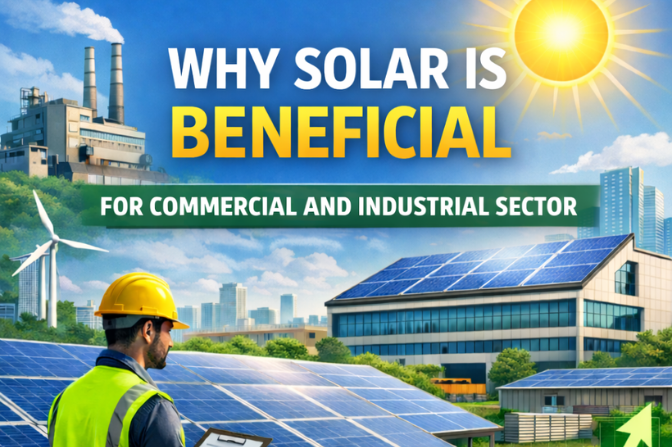
Why Solar Is Beneficial For Commercial And Industrial Sector
With rising electricity tariffs, sustainability pressure, and the need for long-term cost control, solar energy has become a strategic investment for commercial and industrial (C&I) companies. From manufacturing units and warehouses to IT parks, hospitals, and educational institutions, businesses across India are adopting solar power to improve profitability and resilience.
Below are the key reasons why solar is a smart choice for C&I companies.
1. Significant Reduction in Energy Costs
Electricity is one of the highest operating expenses for commercial and industrial facilities. Solar power allows businesses to generate their own electricity at a fixed cost for 25+ years, reducing dependency on DISCOM tariffs that increase annually.
- Savings of 30–70% on electricity bills
- Protection from future tariff hikes
- Faster ROI due to high daytime energy consumption
2. Attractive Return on Investment (ROI)
Solar projects for C&I companies typically offer high and predictable returns, often outperforming traditional investment options.
- Payback period of 3–5 years
- Lifespan of 25+ years
- IRR ranging between 18–25% (depending on usage and tariffs)
After payback, electricity is virtually free, directly improving profitability.
3. Government Incentives & Policy Support
The Indian government actively promotes solar adoption through favorable policies:
- Net metering / gross metering benefits
- Accelerated depreciation (for eligible entities)
- Open access and group captive models
- State-level incentives and exemptions
These policies further enhance project viability for commercial and industrial users.
4. Energy Security & Operational Reliability
Solar power reduces dependence on grid electricity and helps companies manage power outages and voltage fluctuations.
- Stable power supply during peak production hours
- Reduced reliance on diesel generators
- Better energy planning and cost forecasting
When combined with energy storage, solar improves operational continuity even further.
5. Supports ESG & Sustainability Goals
Today, customers, investors, and global partners expect businesses to demonstrate environmental responsibility. Solar energy directly supports ESG (Environmental, Social, and Governance) commitments.
- Reduced carbon footprint
- Lower greenhouse gas emissions
- Improved sustainability reporting and brand image
Many multinational clients prefer suppliers using renewable energy.
6. Efficient Use of Idle Roof & Land Space
Commercial and industrial facilities often have large unused rooftops or open land. Solar plants convert this idle space into a revenue-generating asset.
- Rooftop solar for factories, warehouses, malls
- Ground-mounted solar for industrial campuses
- No interference with core business operations
7. Low Maintenance & Long-Term Reliability
Solar plants require minimal maintenance and have no moving parts.
- Low O&M costs
- Remote monitoring systems
- Proven technology with long warranties on modules and inverters
Once installed, solar runs quietly and efficiently for decades.
8. Competitive Advantage in the Market
Lower energy costs and sustainable operations give C&I companies a strong competitive edge.
- Reduced production costs
- Improved profit margins
- Better positioning for green tenders and international markets
Solar is no longer just an environmental decision—it’s a business advantage.
Conclusion
For commercial and industrial companies, solar energy is not an expense—it is a long-term investment in cost savings, sustainability, and energy independence. With rising power costs and increasing environmental responsibility, adopting solar today ensures business resilience tomorrow.
Now is the right time for C&I companies to go solar and secure their energy future.
Recent Blogs

On-Grid vs Off-Grid vs Hybrid Solar Systems: Which One Is Right for You?
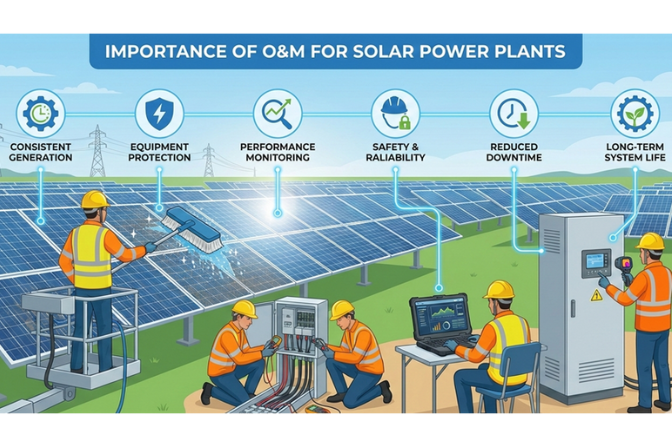
Importance of O&M in Long-Term Solar Power Generation